Belonging to the Four Prime Elements or Principles, Air represents wisdom, freedom, and movement. Only through years of study and practice one can attain the intuition and knowledge necessary to truly master its Power.
Elemental Plane of Air
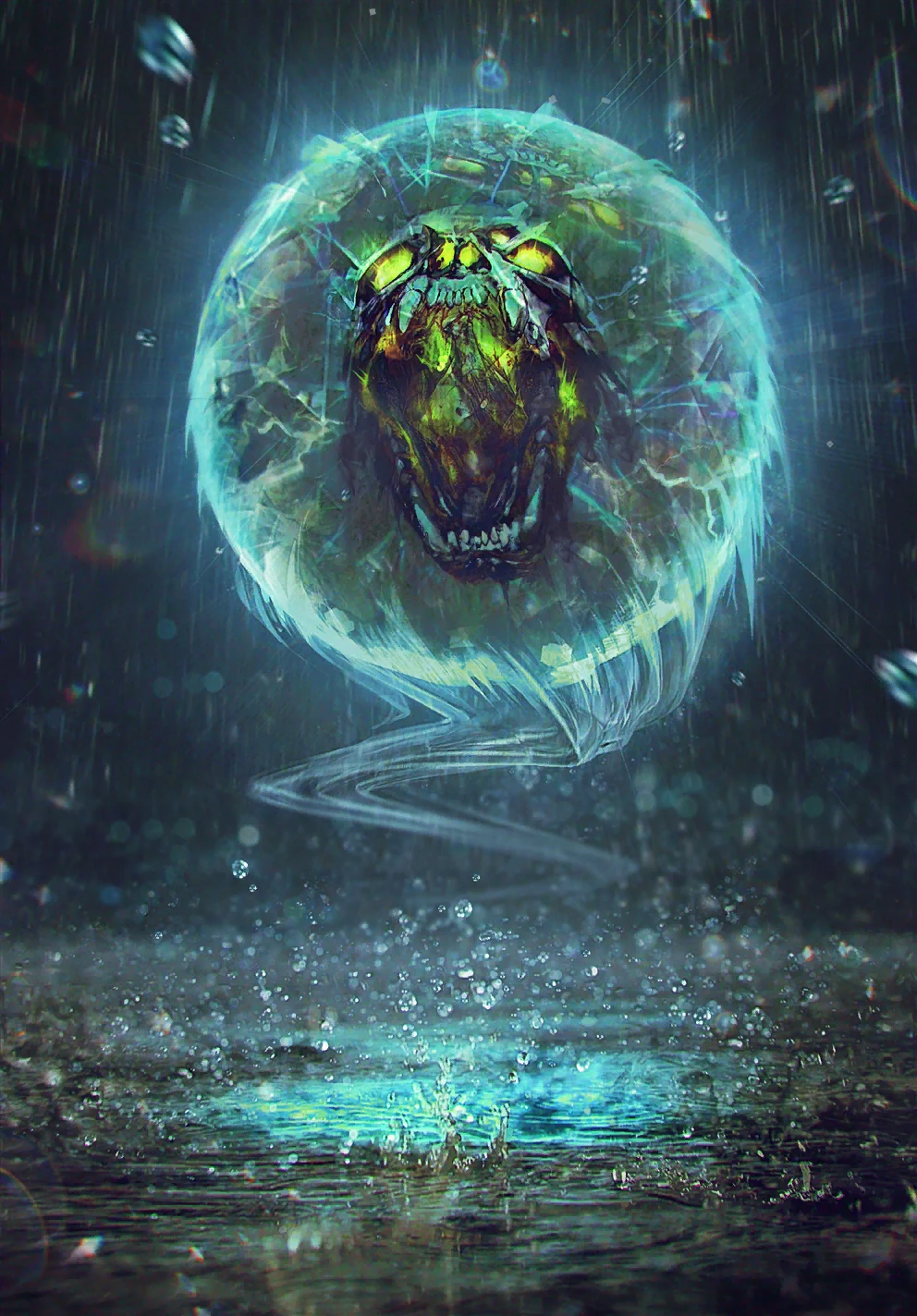
a Djinn
According to Nordling mages and clergy of the Immortal Ones, the Elemental Plane of Air, also called the Dimension of Air or the Air Plane,[3] is a strange universe[4] that consists entirely of the Air Principle.[5] Even though the Plane itself has been out of the reach of natives of the Material Plane[3] since the time of Conjunction,[4] its energy still permeates the material world through ley lines.[6] The elemental Air manifests most strongly where these ley lines meet, at intersections which, in the material world, can be found at mountaintops surrounded by the skies[6] or at tornado-swept plains.[7][N 1]
The Dimension is inhabited by a variety of air elementa,[5] the most powerful of which being djinni, the genies of Air. When summoned to the material reality, djinni act as living reservoirs of Air magical energy and can create whirlwinds and hurricanes. While records exist of powerful sorcerers having forced djinni to serve them,[3] it is much easier to summon and control (and defeat) lesser elemental servants, albeit even these are mortally dangerous.[8]
Air magic
 |
Air—This most fickle and dynamic element also holds impressive potential. Unlike the element of earth, it is much easier to draw upon and requires less effort. This does not mean, however, that it is simpler, for air's capricious nature demands great skill and knowledge. A sorcerer who lacks the appropriate proficiency will simply be unable to attune himself sufficiently to the element and will not draw a satisfactory amount of the Power. A certain intuition is needed, and that comes only with years of experience and constant practice. |  | |
| - pg. 84, The World of the Witcher | |||
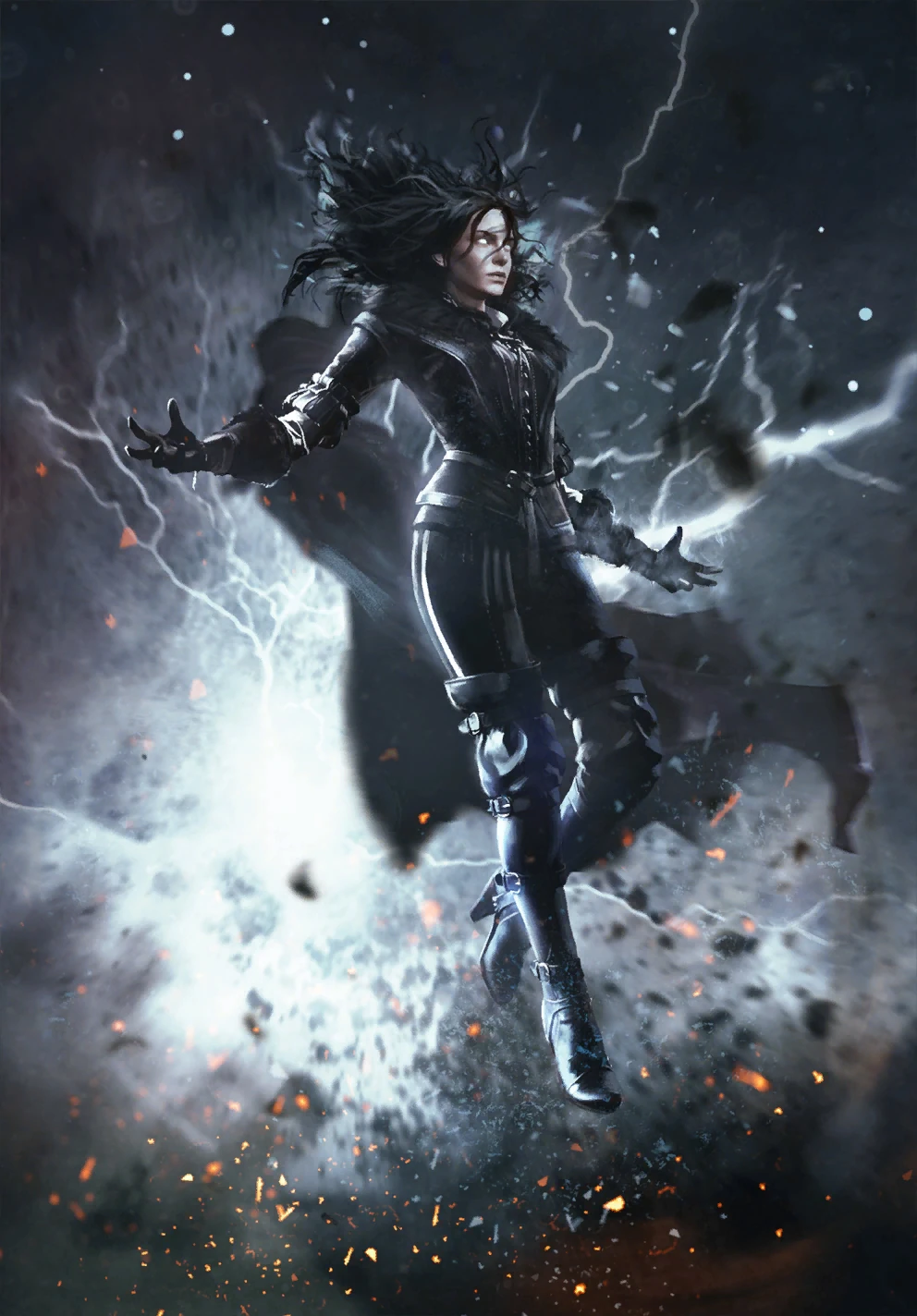
Levitating Yennefer conjuring lightning
While drawing Power from Air requires less strength than from Earth, it is much more difficult than drawing from Water, requiring the practicioner to spend years on study and practice.[9][8][10] To those who have mastered it, Air imparts (temporary) wisdom back: practicioners drawing from its ley lines are able to cast Air spells they have not learned, albeit this does not teach them the spell.[6] The Air Principle is best suited not only for magics that manipulate gases and electricity, but also smells, sounds, and freedom of movement (be that through levitation or increasing the caster's speed).[7][6][10]
In case of overexerting oneself while casting an Air spell, the a gust of wind might explode out of the caster, throwing them back up to two meters;[7] records exist, however, of mages who casted Levitation so badly it made them rise up endlessly, never to be seen again.[11] Drawing too much Power from Air can result in the caster getting knocked out of their feet[7] or accidentaly casting a different spell than intended.[6]
Invocations and spells
For the full list of Air-based abilities, see Category:Air magic.
The manipulation of Air in general is called aerokinesis,[6] whereas communing with the Element in order to reveal people's fates is referred to as aeromancy.[7]
While the common witcher Sign Aard is usually considered a weak form of telekinesis,[9] it is sometimes associated with the element of Air.[12][13][7][10]
Gallery


Footnotes
- ↑ In Season of Storms, Geralt and Dandelion discuss Professor Lindenbrog's alternate theory, according to which elemental planes are not alternate dimensions (as explained by Krepp in The Last Wish) but building blocks of Sphera Mundi, the globe. Geralt explains that the theory is bogus, because meteorites falling on the planet's surface are not infused with the elemental energies they are supposed to pick up while falling, contradicting Lindenbrog's predictions. Later, in the same novel, Sorel Degerlund confirms that elemental and para-elemental planes are considered to be different universes.
It's possible that the Professor simply assumed that ley lines and their intersections, which infuse the world with elemental energies according to Blood of Elves and A Tome of Chaos, are the planet's natural characteristic rather than fissures leading to separate realities.
References
- ↑ Netflix's The Witcher
- ↑ The Witcher 2: Assassins of Kings
- ↑ 3.0 3.1 3.2 The Last Wish
- ↑ 4.0 4.1 Season of Storms
- ↑ 5.0 5.1 A Witcher's Journal
- ↑ 6.0 6.1 6.2 6.3 6.4 6.5 A Tome of Chaos
- ↑ 7.0 7.1 7.2 7.3 7.4 7.5 The Witcher Role-Playing Game
- ↑ 8.0 8.1 The World of the Witcher
- ↑ 9.0 9.1 Blood of Elves
- ↑ 10.0 10.1 10.2 Wiedźmin: Gra Wyobraźni
- ↑ Oko Yrrhedesa
- ↑ The Witcher
- ↑ The Witcher 3: Wild Hunt